
Krampis: the Shetland word for a boiled oat dumpling
Krampis is the old Shetland word for a hearty boiled oat dumpling made with fat — thrifty, warming and steeped in traditional island cooking.
A hearty mouthful of old Shetland
Some words carry the warmth of the kitchen in them, and krampis is one of them. It's a noun from the world of food, describing a boiled oat dumpling made with fat. Simple, filling, and thrifty, it belongs to an older way of eating in Shetland, when nothing edible went to waste and a good meal came from a handful of oatmeal and whatever fat was to hand.
What krampis actually is
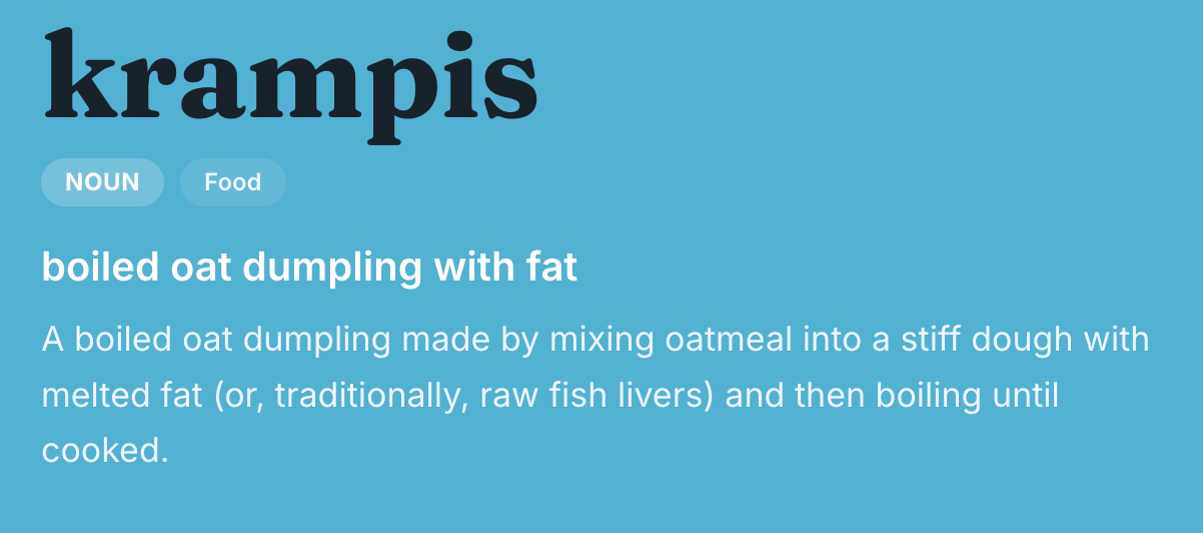
At its heart, krampis is a boiled oat dumpling. You make it by mixing oatmeal into a stiff dough with melted fat, then boiling it until it's cooked through. The result is dense, satisfying and warming — the kind of food designed to keep a body going through a long, cold day.
Traditionally, the fat wasn't always melted fat in the modern sense. In older versions, raw fish livers were worked into the oatmeal instead. That detail tells you a great deal about how Shetland folk cooked: the sea provided, and the rich oil from fish livers was a natural, plentiful source of fat to bind and enrich the dough.
So the recipe, in its essence, is:
- Oatmeal, worked into a stiff dough
- Fat — melted fat, or traditionally raw fish livers
- Boiled until cooked
It's a dish that reflects the resourcefulness of a place where oats and fish were both close at hand.
How and when the word is used
Krampis is very much part of the food vocabulary of Shetland dialect. You'd hear it spoken about food on the table, an everyday word rather than a fancy one. The example sentence shows just how naturally it sits in ordinary speech:
> A'll hae some krampis.
"I'll have some krampis." It's the language of a shared meal, of someone reaching for a helping — plain, direct and homely. There's nothing ceremonial about the word; it's the sort of thing said across a kitchen table.
The tone of the word is warm, and that suits both the dish and the memories it carries. For many, a word like this brings to mind older times and traditional cooking, the food of a household that made much out of little.
Where it sits in the dialect
Krampis comes from Scots, and it belongs to the older era of Shetland dialect. That places it among the words that speak of a particular time and way of life — the traditional foodways of the isles, when meals were built around oatmeal, fat and fish.
Shetland dialect is especially rich when it comes to food, and krampis keeps good company. There's a whole family of hearty, homespun dishes with their own names — think of the oatmeal comfort of brose, a reminder that oats sat at the centre of so many meals. Words like these are more than labels for food; they're small windows into how people lived, cooked and ate.
Why words like krampis matter
A word like krampis is worth holding onto precisely because it's so specific. It doesn't just mean "dumpling" — it means this particular boiled oat dumpling, made this particular way, with fat or fish livers, in this particular place. When a word like that fades, a little bit of everyday history goes with it.
That's the quiet value of dialect food words. They record not only what people ate, but how they thought about their surroundings — the oats grown, the fish caught, the fat saved and used. Krampis is a dish born of practicality and plenty-from-little, and the word itself preserves that story.
For visitors, it's a lovely example of how Shetland dialect and Shetland life are stitched together. For locals, it may stir memories of a warm plate and a familiar kitchen. Either way, it's a word that rewards being spoken aloud and, ideally, tasted.
So next time the talk turns to old-fashioned Shetland fare, you'll know exactly what someone means when they say, "A'll hae some krampis." It's oatmeal, fat and tradition, all boiled into one hearty mouthful — and a small, warm piece of the dialect kept alive every time the word is used.
By OneShetland · part of The Shetland Almanac